Blog › Filming
How to film a football match
An amateur football match is filmed outdoors, on a big pitch, often without a stand, sometimes at three degrees. Placement can be settled in one sentence. What ruins videos is everything else: the turning sun, the wind on the tripod, the battery giving up at the 70th minute.
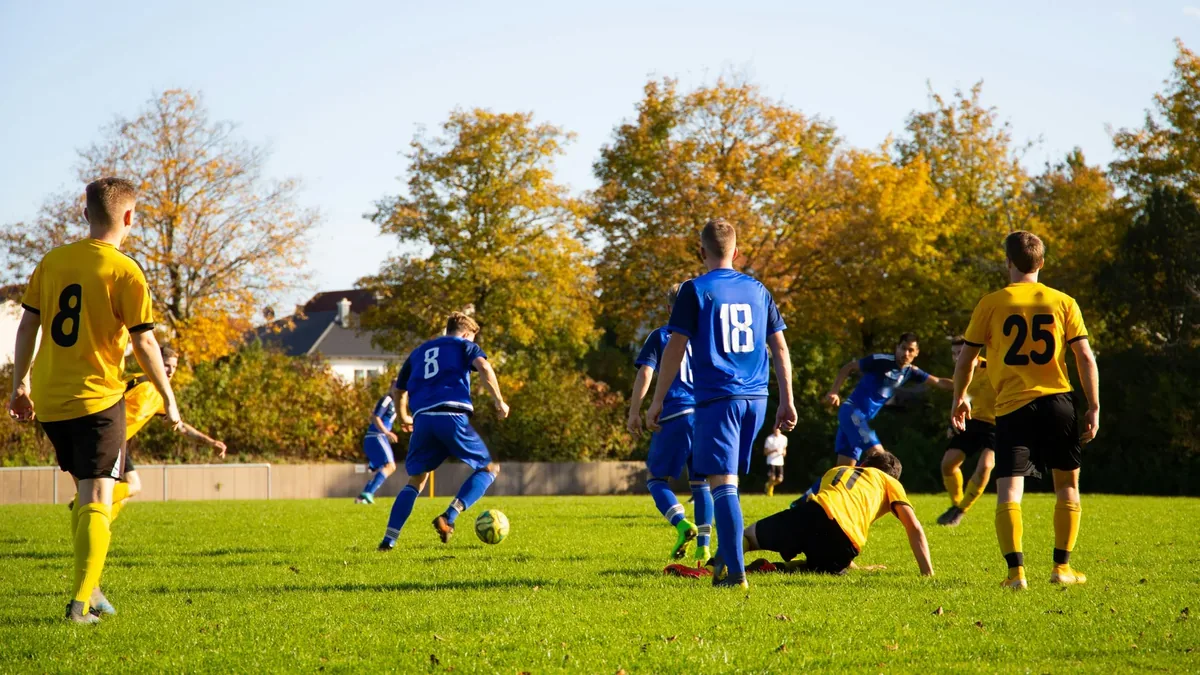
Football is the most filmed sport in clubs, and yet most amateur match videos end up unused. Rarely because of the phone; usually because of a detail forgotten before kick-off. This article follows the order in which things get decided, from the pitch format to the final whistle.
The pitch format decides the number of phones
The Laws of the Game allow an eleven-a-side pitch of 90 to 120 metres long by 45 to 90 metres wide; a club pitch is often around 100 metres long. From the touchline, a phone with normal framing does not cover that length without losing both penalty areas, or without backing off to the point where the players become unreadable.
- Eleven-a-side: two phones stitched together, or just one accepting to lose the ends. For work on set pieces, one is enough, framed on the penalty area.
- Seven-, eight- or nine-a-side (the youth formats, played on a portion of a pitch): a single phone on ultra-wide, from the middle of the length, covers everything.
- Five-a-side and futsal: a single device with normal framing is plenty.
The full calculation (angle, distance, overlap between two devices) is in filming the whole pitch with one phone.
Where to stand: halfway line, above heads
The rule does not change: on the side, level with the halfway line, as high as possible. The reasons and the mistakes to avoid are in where to put the camera. In amateur football, three constraints specific to the ground come on top:
- The railing. Spectators lean on it, standing. A phone set at human height behind them films backs. You have to go above heads: two metres minimum.
- Stray balls. A ball hit hard out over the touchline regularly ends up in the crowd. A tripod planted right at the line is a target: step back a few metres, or stand behind the railing.
- The clubhouse. Many amateur grounds have no stand, but have a balcony, a terrace or a first-floor bar, often near the halfway line. It is often the best spot on the site, and it is sheltered. Ask the club for it before the match.
The sun: think about the second half
In Europe, the afternoon sun is in the south-west, and it drops fast in autumn and winter. Pitches are often oriented roughly north-south, precisely so that the sun is not in line with the goals: the two sides then face east and west. For an afternoon match, the west side of the pitch puts the sun at your back; the east side has you filming into the light, and the players become silhouettes.
The trap is choosing your side at the warm-up. The sun lighting the pitch at 14:30 can be right in the lens at 16:00. In November and December, a match that starts at 15:00 ends close to sunset: the image darkens noticeably in the second half. The setting that adapts to this drop in light is explained in filming a rugby match, which is played in the same conditions.
Wind on an open pitch
A football pitch is a big open space, and the tripod often ends up alone at the edge, with no wall or stand to shelter it. The higher the phone, the more any sway shows in the image: a movement of a few millimetres at the top of the mast becomes a shake on the opposite touchline. Four moves:
- Spread the legs as wide as possible and extend the leg sections first, not the centre column, which is the flimsiest part.
- Weigh it down: a bag hung under the tripod head, a water bottle in a bag.
- Tie the tripod to the railing or a barrier with a strap.
- Go down a notch if the gust is strong. A slightly lower, stable image is better than a high one that shakes.
Cold drains the battery
A lithium battery loses part of its capacity in the cold, and recovers it as it warms up. Apple states an operating range of 0 to 35 °C for its phones. Below that, a phone can still show a good charge and shut off suddenly. A November match at two degrees is exactly that case.
- Keep the phone warm in an inside pocket until the last moment, then set it up just before kick-off.
- Plug in an external battery from the start, and keep it in a pocket or bag, with a cable long enough to reach up to the phone.
- Turn down the screen brightness: it is one of the biggest drains.
- At half-time, check the charge and the remaining space, not just that the recording is running.
For rain, the precautions are the same as in rugby: a cover above the lens and a dry microfibre cloth for the break.
Under floodlights, change the frame rate
Weekday matches and many winter fixtures are played under artificial light. Mains-powered floodlights pulse at the rhythm of the current, 50 Hz in Europe, and can make the image flicker at 30 or 60 frames per second. The fix is to film at 25 or 50 frames per second; the detail is in why my match video stutters or flickers.
Settings, once and for all
- 1080p, landscape. 4K makes files heavier without adding anything to the reading of a positioning.
- Free space. An eleven-a-side match lasts 90 minutes plus half-time. On iPhone, Settings, Camera, Record Video shows the size of one minute in each format: multiply by about a hundred and compare with the space left.
- Do Not Disturb mode, so that a call or a notification does not cover the screen or interrupt the recording.
- Focus locked on the middle of the pitch, so that the device does not refocus on every player passing in front.
Coaching and filming at the same time
The most common case in a club: the coach is alone on the bench, and nobody holds the camera. The full method is in filming a match on your own. The principle: a fixed phone up high that you no longer touch, and a way of marking plays without taking your eyes off the match.
That is what TactiCam's Recall Mode does: the coach taps after the play, from their own phone, and TactiCam keeps the seconds before. At the end of the match, the clips are already in the Video Room. To know what to do with them next, the reading grid is in how to analyse a football match.
Youth teams
Filming minors requires the parents' written consent, and access limited to the team. What a club needs to set up before the first filmed match is detailed in filming minor players.
Frequently asked questions
Where to place the camera to film a football match?
On the side, level with the halfway line, above the spectators' heads: stand, clubhouse balcony or a tripod of at least two metres. If possible on the side where the sun will be at your back.
Is one phone enough for an eleven-a-side pitch?
Not to see the whole pitch: from the touchline, it loses the ends or makes the players unreadable. Two phones stitched together cover the full length. For seven-, eight- or nine-a-side, a single ultra-wide device is enough.
How do you stop the phone shutting down in the cold?
Keep it in an inside pocket until kick-off, plug it into an external battery from the start and turn down the screen brightness. Below 0 °C, battery life drops noticeably.
By sport: Football · Rugby · Field hockey
Read next
Coach the match, keep the clips
With TactiCam's Recall Mode, one tap after the play keeps the previous seconds. Two phones can cover an eleven-a-side pitch and be stitched together automatically. 14-day trial, no credit card.