Blog › Filming
How to film the whole pitch with a phone
The question comes up at the start of every season, and the short answer is disappointing: from the side of an eleven-a-side pitch, a single phone does not cover everything. The cause is geometry, whatever the model. There are three ways to deal with it.
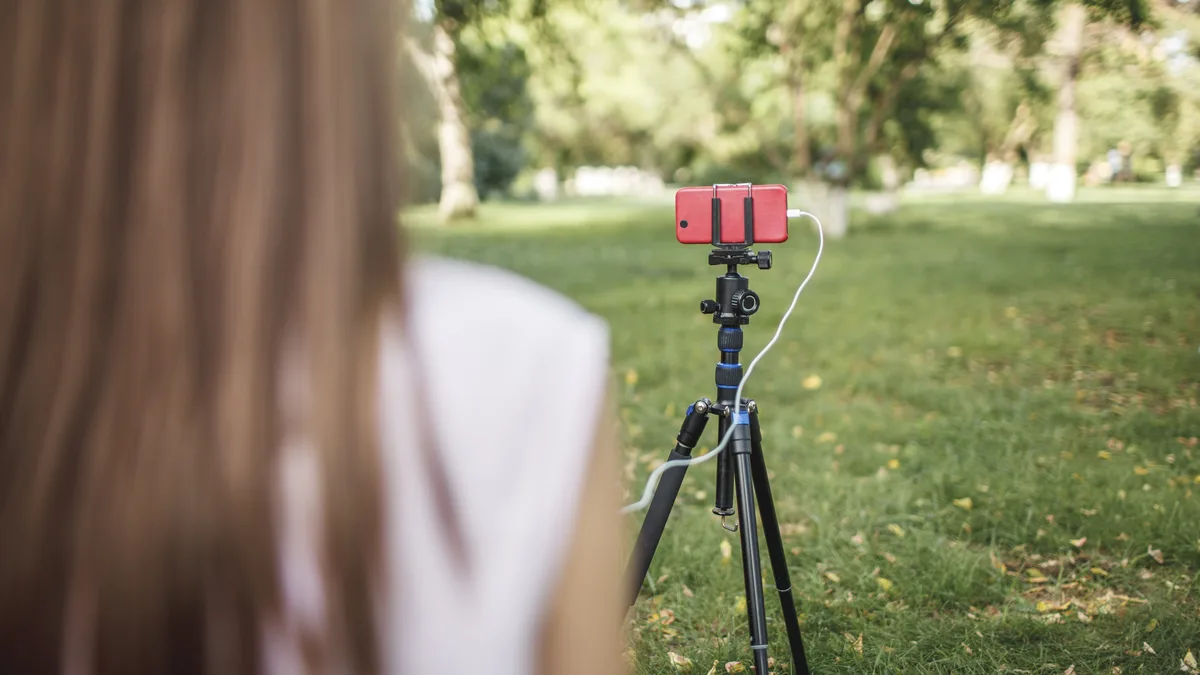
A phone with normal framing sees an angle of about 70 degrees. Placed on the touchline level with the halfway circle, five metres from the line, it covers around sixty metres of width: a seven-a-side pitch, a handball or basketball hall, yes. An eleven-a-side pitch a hundred metres long, no. A quarter is missing on each side, exactly where the restarts and the crosses happen.
Backing off costs legibility
The first idea is to back off. It works on paper: at fifteen metres from the line, the same angle covers the whole pitch. It fails on screen: a player on the opposite touchline, seventy metres away, is only twenty pixels tall in 1080p. You can see that someone is there, but not their number, their orientation, or whether they are watching the play. For reading positioning, it is still usable; for showing a player what they did, it is lost.
Going up is more effective than backing off: from four metres high, the pitch opens up and players separate instead of masking each other. But height does not change the angle. It settles legibility; coverage stays the same. The two questions are distinct, and camera placement deals with the first.
Ultra-wide: yes for seven-a-side, no for eleven
Almost all recent phones have a second lens at 110 or 120 degrees. On a seven-a-side pitch or indoors, it solves the problem: everything fits in the frame from a reasonable point, and the distortion at the edges stays acceptable. On an eleven-a-side pitch, it gets the pitch in, but at the price of three flaws that add up:
- The edges stretch. The penalty areas, precisely what you want to see, are in the most distorted zones of the image.
- Sharpness drops. The ultra-wide sensor is almost always worse than the main one; distant players become blobs.
- The light drops. In the late afternoon or under floodlights, the ultra-wide is the first to give up.
Remember the rule by the width of the pitch: up to sixty metres, a single device on ultra-wide is enough; beyond that, you need two devices or have to accept losing the sides.
Two phones: cover without backing off
The solution that holds up on an eleven-a-side pitch is that of automatic cameras, applied with what the club already owns: two devices side by side, each framing one half, stitched into a single wide image. You keep the distance short, so players stay legible, and you cover everything. Three conditions for the stitching to hold:
- Same height, same point. Both phones on the same tripod or the same bar, a few centimetres apart. Two tripods five metres apart give two viewpoints that cannot be joined.
- An overlap of ten to fifteen per cent. Each device must see a little of the other's half, usually the halfway circle. Without overlap, the seam is a hole; with too much, you lose width for nothing.
- The same settings. Same resolution, same frame rate, exposure locked on both. One device on automatic exposure and the other not produce a visible seam every time a cloud passes.
The stitching itself is done by software, not by hand: manually editing two videos together takes hours and never holds for the whole length of a match. This is where a tool designed for it makes the difference, and it is an implementation detail of the method.
By sport, what you really need
- Eleven-a-side football, rugby: two devices, or just one if you accept losing the twenty metres on each side. To work on set pieces, one is enough, framed on the box.
- Seven-a-side or nine-a-side football, field hockey: one device on ultra-wide from four metres high covers everything.
- Indoors (handball, basketball, floorball, volleyball): one device with normal framing from the stand, raised, covers the whole court. Ultra-wide brings nothing and loses light, which matters more indoors.
What does not work
Clip-on "fisheye" lenses sold for a few francs distort everything and make the centre blurry. 360 cameras split their resolution between two hemispheres: the useful half is at 1080p at best, and the pitch, at twenty metres, is no longer legible. And filming from behind a goal to "see everything in depth" flattens distances to the point where the two lines merge.
Frequently asked questions
Is a clip-on wide-angle lens on the phone enough?
No. Cheap models distort heavily and make the centre blurry. The ultra-wide built into a recent phone is better, and even it is only enough up to sixty metres wide.
Does a 360 camera cover the whole pitch?
It sees everything, but with the resolution shared between two lenses: the half facing the pitch is at 1080p at best, and players at twenty metres are no longer legible.
Do you need to see both goals at the same time?
For collective analysis, yes: it is what lets you read the spacing between the lines. To work on a specific phase, no, and a single device framed tightly is better.
Which resolution should you choose?
1080p. 4K quadruples the file size for a gain that a phone screen does not show. What makes a player legible is distance and height, and resolution matters less.
By sport: Football · Rugby · Field hockey
Read next
Two phones, one image
TactiCam's panorama mode stitches two phones into a single wide, synchronised image, with no editing. The overlap and the seam are handled for you. 14-day trial, no bank card.