Blog › Coaching
Filming a training session, not a match
Training video is for correcting a movement while the player can still redo it.
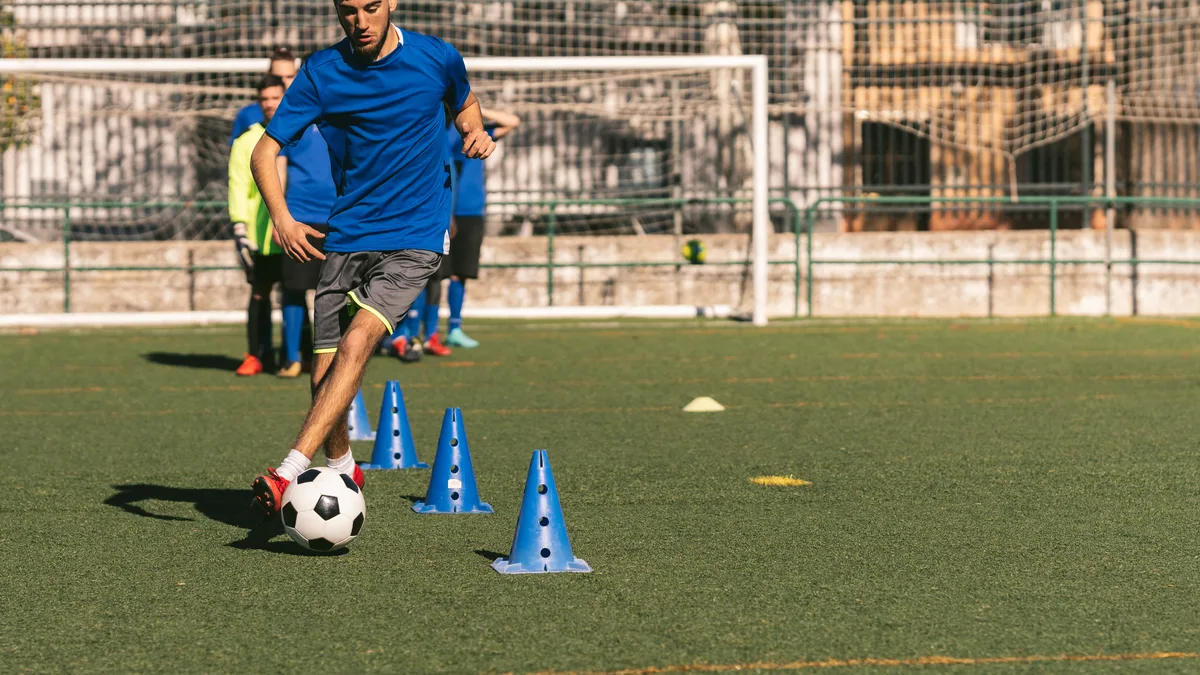
Almost everything written about filming sport is about the match: wide shot, height, analysis on Monday. Applied to training, that model produces two hours of video that nobody reopens. A session calls for the opposite logic: closer, shorter, and immediate feedback.
The one real advantage: the player is still there
A filmed match is watched later, when the situation has gone. In training, the player who has just missed his first touch is ten metres away, in kit, with a ball. Showing the sequence within the minute and then having him redo the movement is the only situation where video produces a correction you can observe the same day.
Everything else follows from this: if the feedback is not immediate, filming a training session has almost no advantage over filming a match.
Film three drills, not the session
The classic mistake is to put the phone down at the side of the pitch and let it run for ninety minutes. You get a huge file, dominated by dead time, instructions and movement, in which the twenty useful seconds cannot be found.
A method that works: choose three moments decided in advance, and film only those.
- A repeated movement: a strike, a throw-in, a serve, a jump shot. This is what video shows best, and often the only way to get a player to accept a flaw when he is convinced he does it differently.
- A small-sided situation, two against two or three against three. Small enough to fit in the frame, rich enough to show a decision.
- A set piece, if you are working on one. This is where positioning gets corrected to the metre, and where video usefully replaces ten minutes of explanation.
Twenty to thirty seconds per sequence is enough. Beyond that, you are filming waiting.
Closer, lower
In a match, height decides everything because you want to read distances between the lines. In a drill, you want to see a foot plant, a shoulder orientation, a reaction time: a phone at head height, ten or fifteen metres away, does better than a five-metre mast. A simple one-metre stand is enough, and it has the decisive advantage of moving from one drill to the next in a few seconds.
Stand three-quarters on rather than face-on or in full profile: it is the angle that shows both what the player does and what he is looking at.
Feedback to the player: fifteen seconds, one instruction
The feedback moment is the one most often missed. Three rules, learned by missing it:
- One instruction per sequence. A player does not retain three corrections; he applies none. Choose the one that matters, leave the other two.
- Individually, never in front of the group. A mistake shown to twelve team-mates stops being a technical point and becomes a judgement. The same clip seen by two people works very well.
- Redo it immediately. The corrected movement must be replayed straight away, otherwise the correction stays an idea. Film it again: the before-and-after comparison is the one moment video proves progress rather than just describing it.
And keep the session moving. If the drill stops while the coach looks for his sequence in the camera roll, the benefit is eaten by the lost time. That is why many coaches give up after three tries. A useful correction is one you find in two taps.
What it does not replace
Training video replaces neither the eye nor the demonstration. It is good on what is repeated and slow to change: a foot plant, a positioning, an orientation. It is weak on what is fast and contextual: real speed, an opponent's pressure, fatigue. Filming a match serves that purpose, and the two uses do not replace each other.
One last point that is not technical: the rules on players' image are the same in training as in a match. A session is a private place, but a clip sent to a young player, or published, falls under the same consents. See what the law requires.
Frequently asked questions
How long should you film in a session?
Two to three useful minutes in total, spread over three drills chosen in advance. Filming the whole session produces a file nobody reopens and makes immediate feedback impossible.
Should you show the video in front of the whole group?
No, except for a collective principle that really concerns everyone. An individual correction is shown to the player alone: in front of the group it is received as a judgement and produces the opposite of the effect you want.
Doesn't it break the rhythm of the session?
If the feedback lasts more than a minute, yes. The rule is to show it while the drill carries on for the others, never by stopping everyone.
From what age is video feedback useful?
As soon as the player can describe what he has just done, so around ten or eleven in practice. Younger than that, the image amuses but does not change the movement: demonstration stays more effective.
By sport: Football · Handball · Tennis
Read next
Find the sequence in two taps
With Recall Mode, you tap once the action is over and the clip is already cut, ready to show the player on the pitch. 14-day trial, no credit card.